
Stained Concrete Basement Floors: Better Than Paint?
Most basements start as plain gray concrete. When it's time to finish the space, people usually weigh three options: paint it, put down epoxy, or stain it. We hear this question on almost every basement call, so here's why we steer most people toward a stained concrete basement floor, straight from a team that has finished concrete floors across Kennesaw and metro Atlanta for more than 20 years.
Why not just paint the basement floor?
Paint is cheap and easy to find, which is why so many basement floors have it. The problem is how it works. Paint is a thin layer that has to hold on to the concrete underneath, and a basement floor takes a lot: foot traffic, furniture dragged across it, kids, pets, and the occasional spill. Once paint starts to let go, it peels and flakes. Touching up one spot almost never matches the rest of the floor.
Is your "bare" concrete floor really bare?
This one surprises people. A lot of the floors we get called about are described as bare concrete. Then the photos come in, and there's a coat of gray paint or an old epoxy coating on it. From across the room, a painted floor and a bare one can look almost the same.
It matters because a new finish has to bond to the concrete itself, not to whatever is sitting on top of it. Any old paint or coating has to be ground off first. That's real work, and it's the biggest reason two basements of the same size can get very different quotes.
A few quick ways to check your own floor:
- Look at the edges. Corners and the strip along the walls often show where a coating stops.
- Check where things used to sit. Under an old washer, freezer, or workbench, worn spots can show a different color underneath.
- Look at any chips. If a chip shows a different color below the surface, the floor has a coating on it.
Not sure? Send us a few photos. We can usually tell.
Pulled up old carpet? Have an older floor?
Pull up old carpet and you'll find a row of small nail holes along every wall, where the tack strip was. Unlike a lot of companies, we take the extra time to fill those little holes all the way around the room. When the floor is done, it looks like they were never there.
An older slab is usually fine too. Any concrete can be stained if it's stable, meaning it hasn't shifted in height and isn't badly cracked. Some floors need a micro-topping first. That's a very thin coat that gives us a clean surface to start from.
What about epoxy?
Epoxy is a thick coating that's rolled on over the top of the floor. We don't install it, and here's why. Over time, epoxy fades and can change color. It scratches easily. It can also bubble, and once it does, there's really no way to patch it.
We run into old epoxy a lot. When a basement has an epoxy coating and the owner wants a stained floor, the epoxy has to be ground off first, the same as paint.
If you want a floor that looks like stone, slate, tile, marble, or leather instead of one solid color, that's where staining comes in.
Why a stained concrete basement floor works
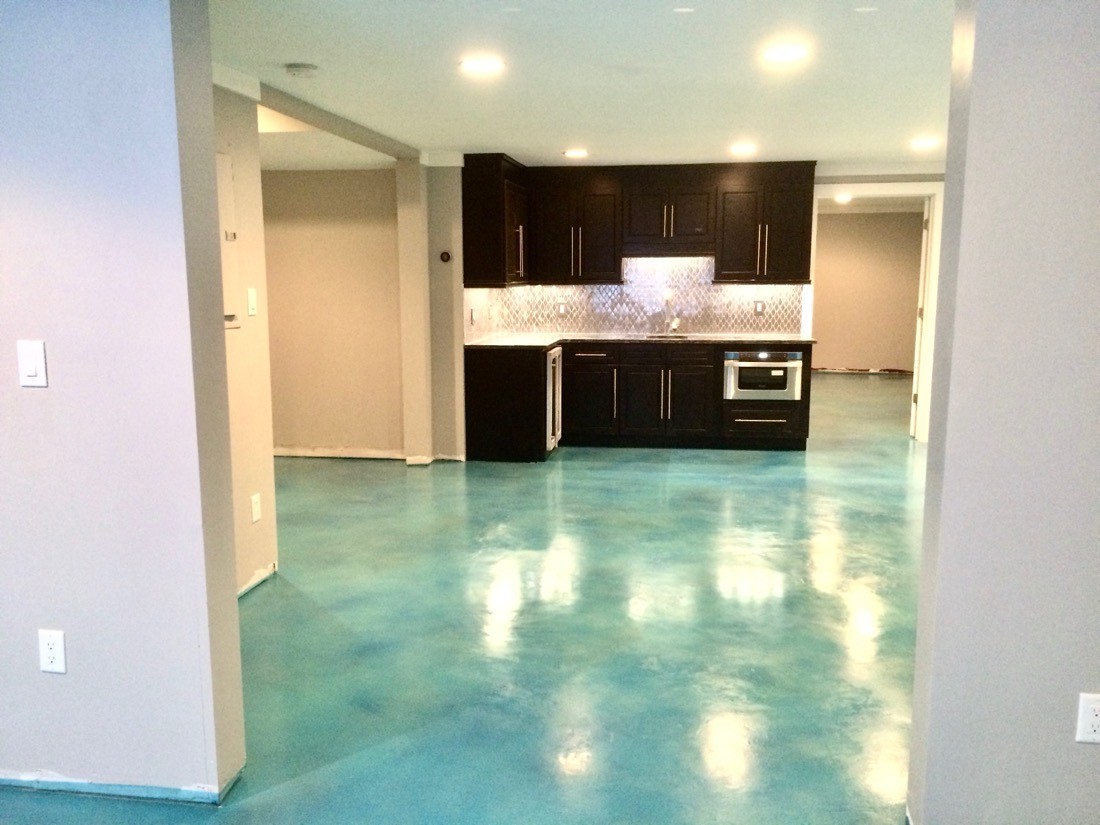
A stained floor starts with prep. We get the concrete clean and sound, then build the color on the prepared surface and lock it in under a clear sealer. You pick the look: warm browns, grays, deep charcoals, or a custom color, plain or with a stone-like texture. The color you approve is the color you get.
Basements are also one of the easiest places for a stained floor to live. Indoors, there's no rain or sun working on it, so a stained basement floor doesn't need us to come back and reseal it. We set you up with a simple system so you can refresh it yourself if you ever want to.
See more finished rooms on our basement floors page, or read how our interior concrete staining works from start to finish.
How much does it cost to stain a basement floor?
In most cases, staining a basement floor costs half as much as wood, tile, or carpet, or less. That's a big part of why people choose it. You're using the slab you already have instead of covering it up with something new.
The floor you start with moves the price more than anything else:
- A clean or newer slab needs very little prep, so more of your money goes into the finish.
- A floor with paint or an old coating needs heavy grinding before anything else can happen.
- The size of the room and the look you pick matter too. One color costs less than a detailed, multi-tone design.
Most of the time we can give you a number over the phone. Photos of the floor and a rough idea of the square footage are usually all we need.
Before you call: a quick checklist
- Measure the room. Length times width is close enough.
- Take a few photos in good light, including one close-up of the surface.
- Check for paint or an old coating using the tips above.
- Think about how you'll use the room: game room, office, theater, or a place for the kids.
That's everything we need to give you a solid answer. Learn more about our concrete staining services in metro Atlanta, or call us for a free, no-pressure quote.
Frequently asked questions
Is it better to paint or stain a basement floor?
For a basement you plan to live in, stain and seal it. Paint is a thin layer that has to hold on to the concrete, and once it starts to let go it peels and flakes. A stained floor gets its color on the prepared concrete and is locked in under a clear sealer.
Can you stain a basement floor that has already been painted?
Yes, but the paint has to come off first. A new finish needs to bond to the concrete itself, so old paint or epoxy gets ground off before anything else happens. That extra grinding is the biggest reason two basements of the same size can get very different quotes.
Can you stain an older basement floor?
Yes, as long as the slab is stable. Any concrete can be stained if it hasn't shifted in height and isn't badly cracked. Some older floors need a micro-topping first, a very thin coat that gives us a clean surface to start from.
How much does it cost to stain a basement floor?
In most cases, staining costs half as much as wood, tile, or carpet, or less. The floor you start with moves the price the most. A clean or newer slab needs little prep, while a floor with paint or an old coating needs heavy grinding first. We can often give you a number over the phone.
Does a stained basement floor need to be resealed?
Not by us. Indoors, there is no rain or sun working on the finish, so a stained basement floor does not need a return visit to reseal it. We set you up with a simple system so you can refresh it yourself if you ever want to. Outdoor concrete is different and needs resealing every two to three years.